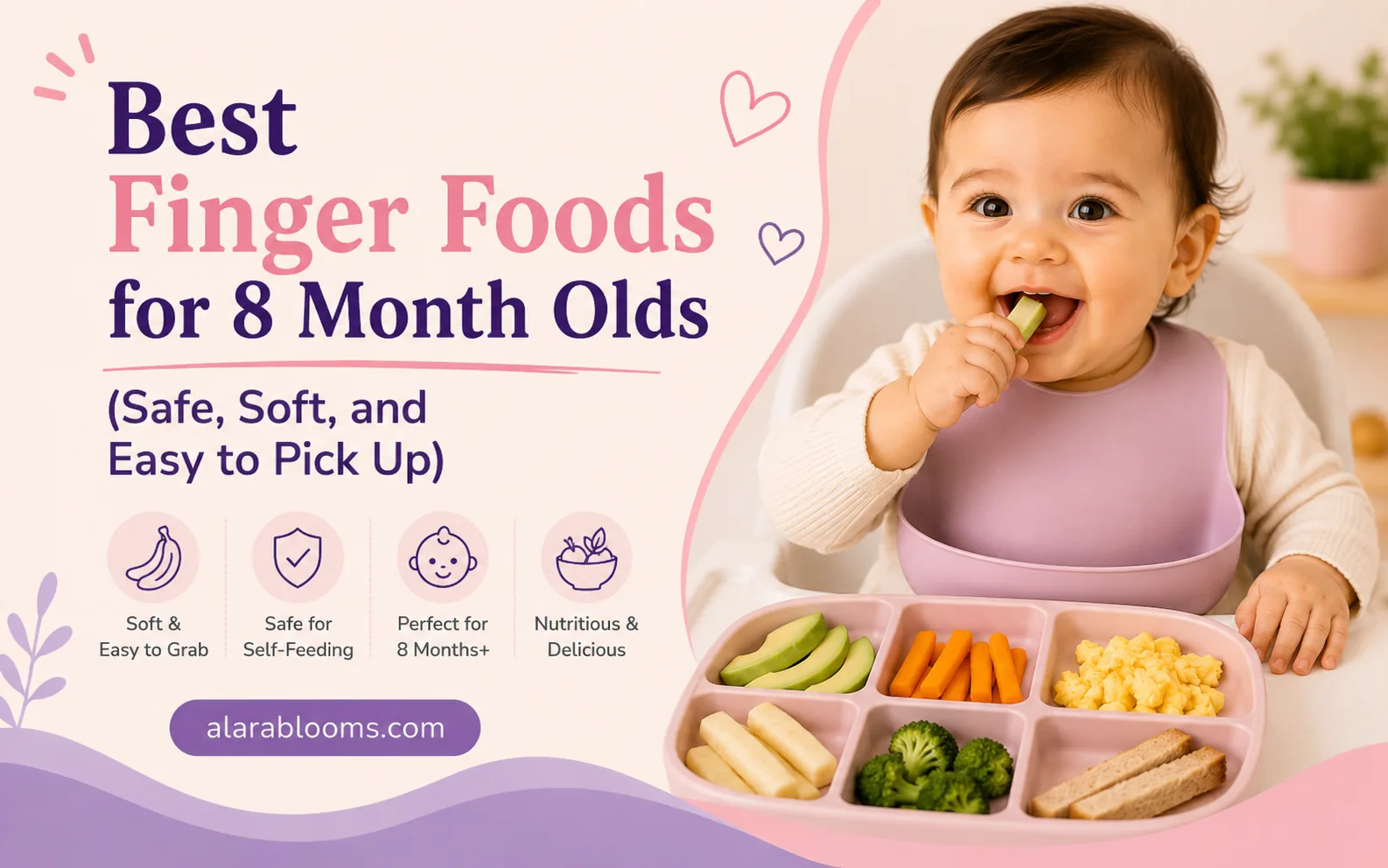
At eight months, most babies are raking food toward themselves and attempting to get it into their mouths under their own power. The pincer grasp — that precise thumb-and-forefinger pickup — is still developing, but the drive to self-feed is fully present. That motivation is worth encouraging. Finger foods are not just a feeding method; they're a developmental opportunity.
The concern parents have most often is choking. It's a legitimate worry, and the right response is preparation — knowing which foods are safe, how to cut them, and what to do if a piece becomes an issue. But fear of choking shouldn't delay finger food introduction past the developmental window, because babies who are kept on purees too long often develop texture aversions that take real work to address later.
When Are Babies Ready for Finger Foods?
Most babies show readiness for finger foods between seven and nine months, with eight months being a typical starting point. The key signs are:
Sitting steadily with support. A baby needs to be upright to eat safely. If your baby cannot sit without slumping, wait a few more weeks — eating reclined significantly increases choking risk.
Bringing objects to their mouth. If your baby is picking things up and putting them in their mouth during play, they're ready to extend that skill to food.
Showing interest in what you're eating. Reaching toward your plate, watching your fork intently, opening their mouth when they see you chew — these are all signals that the social and sensory interest in food is primed.
Good head and neck control. The ability to move their head freely means they can respond appropriately to food in their mouth — tipping back if something feels wrong, moving food with their tongue.
Why Finger Foods Matter
Finger foods are not just about getting calories in. They're an active developmental exercise. Picking up a piece of food, moving it to the mouth, and managing it once it's there requires coordination between the hands, eyes, and oral motor system. Every attempt — even the ones that end with the food on the floor — is building those neural pathways.
There's also evidence that early exposure to self-feeding is associated with lower rates of food refusal and picky eating in toddlerhood. Babies who have been in control of their food — choosing what to pick up, deciding when to put it in their mouth — appear to develop a different relationship with eating than babies who are only spoon-fed. The autonomy seems to matter.
The Golden Rule for Finger Foods
There is one test that covers the vast majority of finger food safety decisions: can you squish it between your thumb and forefinger with light pressure? If the food compresses easily and would not resist gumming in a baby's mouth, it is almost certainly safe to offer. If it is firm, springy, round, or breaks into sharp pieces rather than compressing, hold off.
This applies to every food on the list below and to any food you're considering introducing at home. Soft, squidgy, and dissolvable are the words to hold in your head when assessing a new finger food.
How to Cut Finger Foods Safely
How you cut food matters as much as what food you choose. The most important rule is to avoid round coin shapes for anything that could become firm in the mouth — grapes, cherry tomatoes, blueberries, and sliced hot dogs are all classic examples. Round, firm shapes can form a seal in the airway that is very difficult to dislodge.
The safer cuts are: small cubes (roughly half a centimeter), long strips or spears (so the baby can hold one end and gnaw the other), or pieces that are flat and irregular in shape. For grapes and blueberries, cut into quarters lengthwise — not halves. For anything banana-shaped, a lengthwise cut that produces a spear works better than rounds.
Top 10 Finger Foods for 8 Month Olds
Banana is one of the best starting finger foods because it is naturally soft, easy to gum, and nutritionally solid — potassium, vitamin B6, and quick energy. One useful trick: drag a fork along the length of the banana before cutting into pieces. The lines create grip that makes it easier for a baby's raking hand to pick up. Cut into short spears or cubes about half a centimeter across. Very ripe bananas (with brown spots) are softer and easier to manage.
Ripe avocado is an ideal early finger food — soft enough to dissolve with minimal gumming, rich in healthy fat that supports brain development, and mild in flavor. The challenge is the slipperiness: avocado is notoriously hard for a baby's developing grip to hold. Rolling pieces lightly in hemp seeds or finely ground puffed rice can help with traction. Cut into cubes around half a centimeter and serve immediately after cutting.
Raw carrot is a choking hazard. But carrot roasted or steamed until a fork glides through without resistance becomes one of the best early finger foods — naturally sweet, easy to grip as a stick, and structurally stable enough that babies can gum it effectively without it breaking into hard pieces. Cut into sticks about five centimeters long so the baby can hold one end while chewing the other. The "stick" format is ideal for eight-month-olds who are still developing their pincer grasp.
Soft-scrambled eggs cut into small pieces are an excellent early finger food — high in protein, choline, and healthy fat, and they cook in under three minutes. The key is to cook them low and slow, pulling them off the heat while they look slightly underdone, so they stay soft rather than becoming rubbery. Rubbery eggs are a texture most babies reject, and they're also harder to gum through. Serve at room temperature so they're not slippery from steam.
A small broccoli floret is one of nature's most convenient baby finger foods — the stem is a natural handle that an eight-month-old can grip with their whole fist while they gnaw on the floret end. Steam until the floret is very soft and the stem bends without snapping. The slightly irregular texture of broccoli is also excellent oral motor practice. Broccoli provides vitamin C, folate, and a small amount of calcium, making it a nutritionally worthwhile addition to any meal.
Mild cheddar, mozzarella, and Colby Jack cut into small cubes (around half a centimeter) are easy to grip and provide calcium, fat, and protein. Choose full-fat cheese — the fat is important for brain development at this stage. Avoid processed cheese slices, which have very high sodium. Cheese also has the useful quality of not requiring any cooking or preparation time, making it a go-to option when you need something quick and nutritious.
Very ripe pear and peach, peeled and cut into small pieces, are excellent early finger foods. The ripeness is important — underripe pear is firm enough to be a hazard. Press your thumb into the flesh: if it gives easily, it's ready. Peel the skin off both, as the skin can be a texture issue and peach skin in particular can feel surprising in a baby's mouth. Dice into small cubes or cut into thin strips. Both fruits provide vitamin C and natural sweetness that most babies respond well to.
Cook pasta well past al dente until it is soft enough to squish between your fingers. Small shapes work better than long noodles at this stage — penne, rotini, small shells, or orzo. Rotini and penne are particularly good because the ridges and tubes give babies something to grip. Toss with a small amount of olive oil to prevent sticking and serve at room temperature. Pasta is carbohydrate-dense, which provides good energy for active eight-month-olds.
Soft or silken tofu cut into small cubes dissolves quickly in the mouth with almost no gumming required, making it one of the safest finger foods for this age. It provides plant-based protein and calcium, is very mild in flavor, and holds its shape well enough to be picked up. Drain thoroughly, pat dry, and serve at room temperature. The blandness of plain tofu means it pairs well with any seasoning you're using elsewhere in the meal.
Roasted sweet potato is one of the most nutritionally dense finger foods you can offer. It provides beta-carotene, vitamin C, potassium, and fiber, and roasting develops a natural sweetness that most babies find irresistible. Roast cubed sweet potato at a high temperature until fork-tender with slightly caramelized edges — the exterior provides a little grip while the interior is soft enough to gum easily. Cut into small cubes around half a centimeter before serving.
Gagging vs. Choking: What You Need to Know
Gagging is normal. Choking is an emergency. They look very different. Gagging is the mouth's protective reflex — your baby's gag reflex is positioned much further forward in their mouth than in adults, which means it triggers easily and frequently as they learn to manage solid food. When a baby gags, they go quiet and focused, may make a retching sound or motion, may turn slightly red, and usually resolve it on their own in a few seconds. Do not intervene — watch calmly. Choking, by contrast, is silent. A choking baby cannot cry, cannot cough effectively, may go pale or blue around the mouth, and is in genuine distress. This requires immediate first aid. Learning infant choking response before starting finger foods is strongly recommended — a one-hour CPR and first aid class covers exactly what to do and gives you real confidence at the table.
The single most reassuring thing parents report after starting finger foods is that gagging — while alarming to watch — resolves almost immediately and becomes much less frequent within a few weeks as the baby's oral motor skills develop. The reflex is doing its job. The best thing you can do is stay calm, resist the urge to sweep the baby's mouth, and let their system handle it.
Always Supervise, Always Sit Upright
Two rules that have no exceptions: your baby must be sitting upright in a high chair or supported seat when eating finger foods — never reclined, never lying down, never in a car seat. And an adult must be in the room and watching throughout every meal. Not in the next room with a clear line of sight. In the room, paying attention.
This isn't about hovering anxiously over every bite. It's about being present enough to respond quickly if something goes wrong. Most of the time nothing will — but finger food meals are not a time to multitask.
Track Your Baby's Self-Feeding Milestones
Log when baby first tried each finger food, how they did, and what they loved — build a complete feeding history in Alara Blooms.
Start Tracking FreeFoods to Never Offer Before 12 Months
Foods that are off the table before 12 months
- Honey — risk of infant botulism; no exceptions, including in baked goods
- Whole grapes, whole blueberries, whole cherry tomatoes — always quarter lengthwise
- Raw hard vegetables — raw carrot sticks, raw apple slices, raw celery
- Whole nuts and large globs of nut butter — spoon a thin layer on toast instead
- Popcorn — pieces are too unpredictable in size and shape
- Hot dogs or sausages cut in rounds — always cut lengthwise into strips first, then dice
- Hard or chewy candies, gummy sweets
- Cow's milk as a main drink — fine in cooking and on cereal, not as a bottle or cup drink
- Foods with significant added salt — a baby's kidneys cannot process high sodium
- Added sugar — there is no reason to introduce it this early
As your baby moves through eight and nine months and approaches their first birthday, the list of safe foods grows quickly. The restrictions above are not forever — most of them lift at twelve months. What you're doing right now is building a solid foundation: a baby who is comfortable with texture, interested in a variety of foods, and developing the fine motor skills and confidence to eat more independently every week.