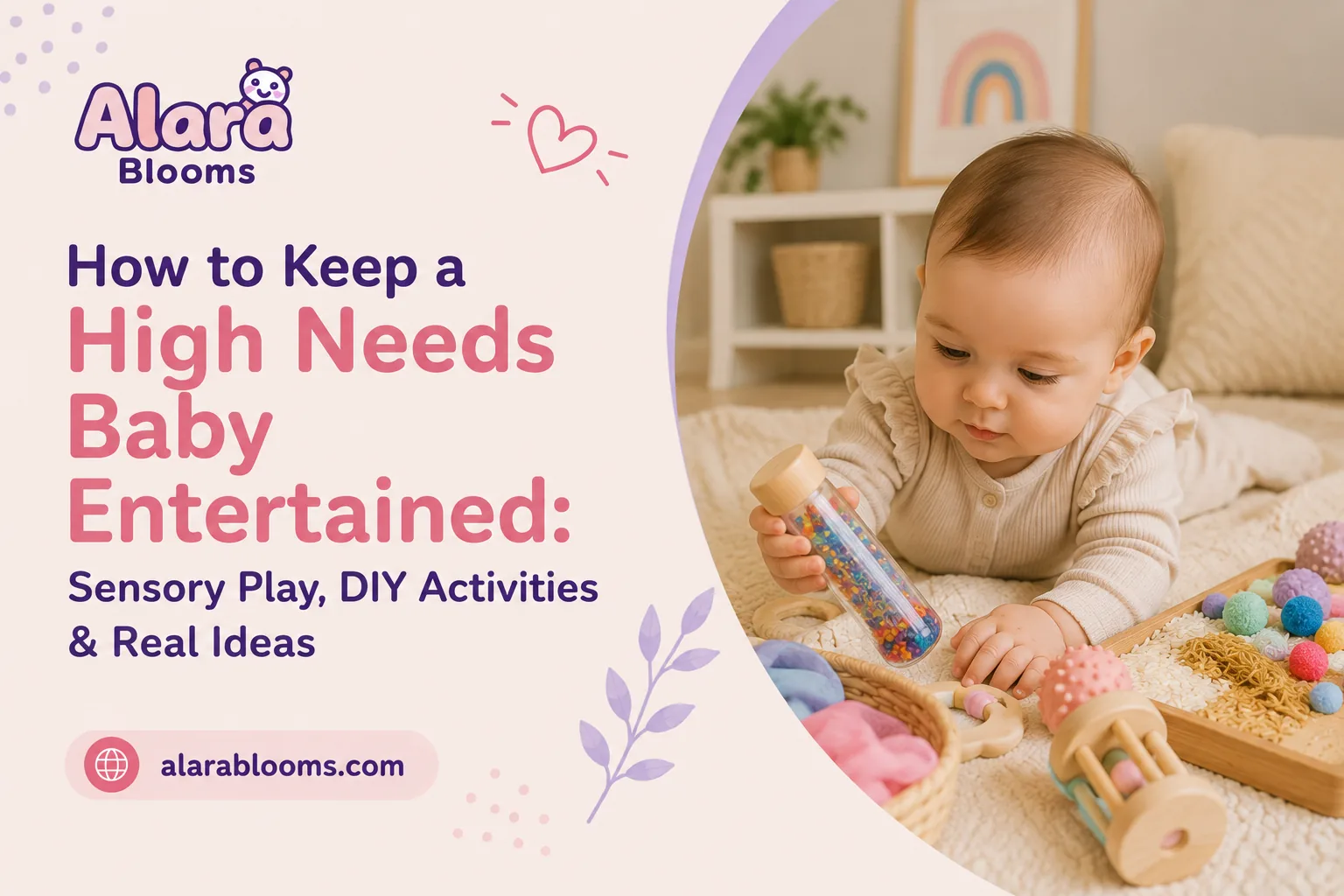
If you've ever felt like your baby needs more entertainment than seems reasonable — more novelty, more movement, more input, more everything — you're not imagining it, and you're definitely not doing anything wrong. High needs, orchid, and highly sensitive babies genuinely experience the world more intensely. That means both boredom and overstimulation hit them faster and harder than they do a more easygoing baby, which is exactly why the same rattle that entertains a friend's baby for twenty minutes buys you ninety seconds with yours.
The good news: once you understand what your baby's nervous system is actually asking for, entertaining them stops feeling like a mystery you keep failing to solve.
Why High Needs Babies Are Harder to Entertain
It's not that your baby is more demanding for the sake of it. Sensitive and high needs babies tend to process sensory information — sound, touch, movement, visual stimulation — more deeply than other babies. A toy that offers one type of input (say, a single sound and a single texture) gets "used up" cognitively much faster for a baby whose brain is already working hard to take in and process everything around them. They're not bored because they're spoiled; they're bored because their brain has already extracted everything that toy has to offer, and it's ready for the next thing.
At the same time, that same deep processing means overstimulation is a real and fast-arriving risk. The line between "engaged and having fun" and "overwhelmed and melting down" can be thinner and closer together than it is for other babies — which is why variety and pacing matter more here than for most.
Reading the Signs: Understimulated vs. Overstimulated
Both understimulation and overstimulation can look like fussiness from the outside, but they call for opposite responses — offering more input to an overstimulated baby (or less to a bored one) tends to make things worse. A quick way to tell them apart:
- Whiny or grizzly fussing, not full distress
- Reaching, grabbing at things nearby
- Squirming, trying to move or change position
- Brightens quickly when offered something new
- Turning face or body away, gaze aversion
- Arching back, pushing away from you
- Sudden, intense crying that escalates fast
- Hiccups, yawning, or fisted hands in babies
When in doubt, offer a lower-key option first — a quiet texture to touch, dim lighting, your voice instead of a toy's sound effects — and watch which direction your baby leans. That single read will save you a lot of trial and error.
Sensory Toys Worth Trying
Not all sensory toys are created equal for a sensitive baby — the best ones offer rich input in one channel at a time, rather than overwhelming with lights, sounds, and textures all at once (which is often more overstimulating than entertaining for this kind of baby).
- High-contrast cards or books — especially valuable in the first few months, when a young baby's vision responds strongly to bold black-and-white or high-contrast patterns
- Textured balls and fabric toys — different ridges, bumps, and fabrics (silicone, corduroy, crinkle fabric, silky ribbon) give tactile variety without overwhelming other senses
- Cause-and-effect toys — simple push-button or shake-to-sound toys that respond predictably; predictability is genuinely soothing for a sensitive nervous system
- Textured play mats or blankets — let a baby explore different surfaces (silky, bumpy, ribbed) with hands, feet, and eventually crawling, all in one low-effort setup
- Unbreakable mirrors — babies are fascinated by faces, and their own reflection offers endless, self-directed novelty
- Simple wooden toys — often better tolerated than battery-operated toys with unpredictable lights and sounds, which can tip a sensitive baby into overstimulation quickly
If a toy claims to do five things at once — light up, play music, vibrate, and talk — it's often too much for a sensitive baby's system. Simpler, quieter toys frequently hold their attention longer than the "exciting" ones.
Proprioceptive "Heavy Work" for Big Feelings
Proprioceptive input — activities that involve pushing, pulling, squeezing, or carrying weight — is some of the most reliably calming and regulating input available, and it works well both for entertainment and for settling big emotions. This is one of the most underused tools for sensitive babies and toddlers.
Rhythmic, predictable bouncing provides calming proprioceptive and vestibular input at the same time — a favorite for regulating an unsettled baby.
A firm (not ticklish) hug, a baby massage with lotion, or swaddled containment for a younger baby all provide deep-pressure input that tends to calm rather than excite.
The combination of gentle pressure, close contact, and rhythmic movement while worn is one of the most effective calming-and-entertaining combinations for a high needs baby, and it frees your hands at the same time.
Pushing a soft toy, a light basket, or (once walking) a push toy gives an older baby or toddler proprioceptive input through their arms and core — genuinely tiring in the good way.
DIY Sensory Activities You Can Set Up in Five Minutes
You don't need a Pinterest-worthy sensory bin setup — most of the richest sensory play comes from ordinary household items.
For babies who still mouth everything, a shallow bin of dry oats (or cooked, cooled pasta) is safe to explore with hands and mouth. Add measuring cups and spoons for scooping and pouring.
Fill a basket with safe household items of different textures — a soft washcloth, a wooden spoon, a silicone spatula, a crinkly paper bag, a cool metal measuring cup. Rotate the items weekly to keep it feeling new.
A clear plastic bottle filled with water, glitter, and a few small floating beads (lid glued or taped shut) makes a mesmerizing, hands-off visual toy — great for a fussy stretch when you need both hands free for a minute.
A damp washcloth, folded and frozen, gives cold tactile input that's especially soothing during teething — novel texture and temperature relief in one.
An empty box (from a delivery you already opened) is genuinely one of the highest-value toys available — climb in, tap on it, crinkle the flaps, hide toys inside. Zero cost, endless novelty.
⚠️ Always supervise sensory bin and small-object play closely, and skip anything with small, swallowable pieces for babies who are still mouthing objects. When in doubt, stick to food-based fillers (oats, cooked pasta) rather than beads or rice for babies under 2.
Getting Outside: Why the Park Works So Well
Fresh air and outdoor time are genuinely regulating for a sensitive nervous system — natural light, open space, and the unpredictable-but-gentle sensory input of wind, grass, and birdsong tend to be easier to process than the concentrated stimulation of an indoor room full of toys. Many parents of high needs babies find outings go noticeably better than time at home on hard days, once they work around a few sensitive-baby-specific considerations:
- Go at off-peak times — an empty park at 9 a.m. is a very different sensory experience than a crowded one after school lets out
- Bring a comfort item — a familiar blanket, toy, or your own babywearing carrier gives your baby a stable "home base" of sensory input in a new environment
- Plan for a shorter outing than you'd expect — 20-30 minutes of genuinely enjoyable park time often beats a full hour that ends in a meltdown from accumulated overstimulation
- Grass and sand time count as sensory play — bare feet on grass, digging in sand, or touching tree bark are rich, low-cost sensory input you can't easily replicate indoors
- Watch for the early signals — catching overstimulation before full meltdown (see the signs above) makes it much easier to wind an outing down gracefully instead of in crisis
Building Toward Independent Play
If your high needs baby seems allergic to playing alone for even thirty seconds, know that independent play is a skill that develops gradually — and sensitive babies often need more scaffolding to get there, not because something is wrong, but because being alone with sensory input they can't fully regulate yet feels genuinely harder for them.
Building Independent Play, Step by Step
- Start with "together, but not interacting": sit nearby doing something else while your baby plays, rather than leaving the room entirely
- Rotate toys often: a small, ever-changing selection holds attention longer than a toy box dumped out all at once
- Keep sessions short at first: two to three minutes of independent play is a real win for a baby who's struggled with it — build up gradually from there
- Choose calm moments to practice: right after a nap or feed, when your baby is regulated, works better than trying it during an already-fussy stretch
You are not failing if your baby needs more of you than the parenting books describe. A sensitive nervous system needs more scaffolding, not less patience from you — and that scaffolding pays off over time.
Most of all, know that a "high needs" label for entertainment purposes usually softens as your baby grows, gains more ways to communicate, and develops their own strategies for self-regulation. What feels exhausting and constant right now is genuinely a phase, even on the days it doesn't feel like one.
Track What Actually Works
Log which activities calm your baby, which overstimulate them, and spot the patterns — with Alara Blooms.
Start Tracking Free