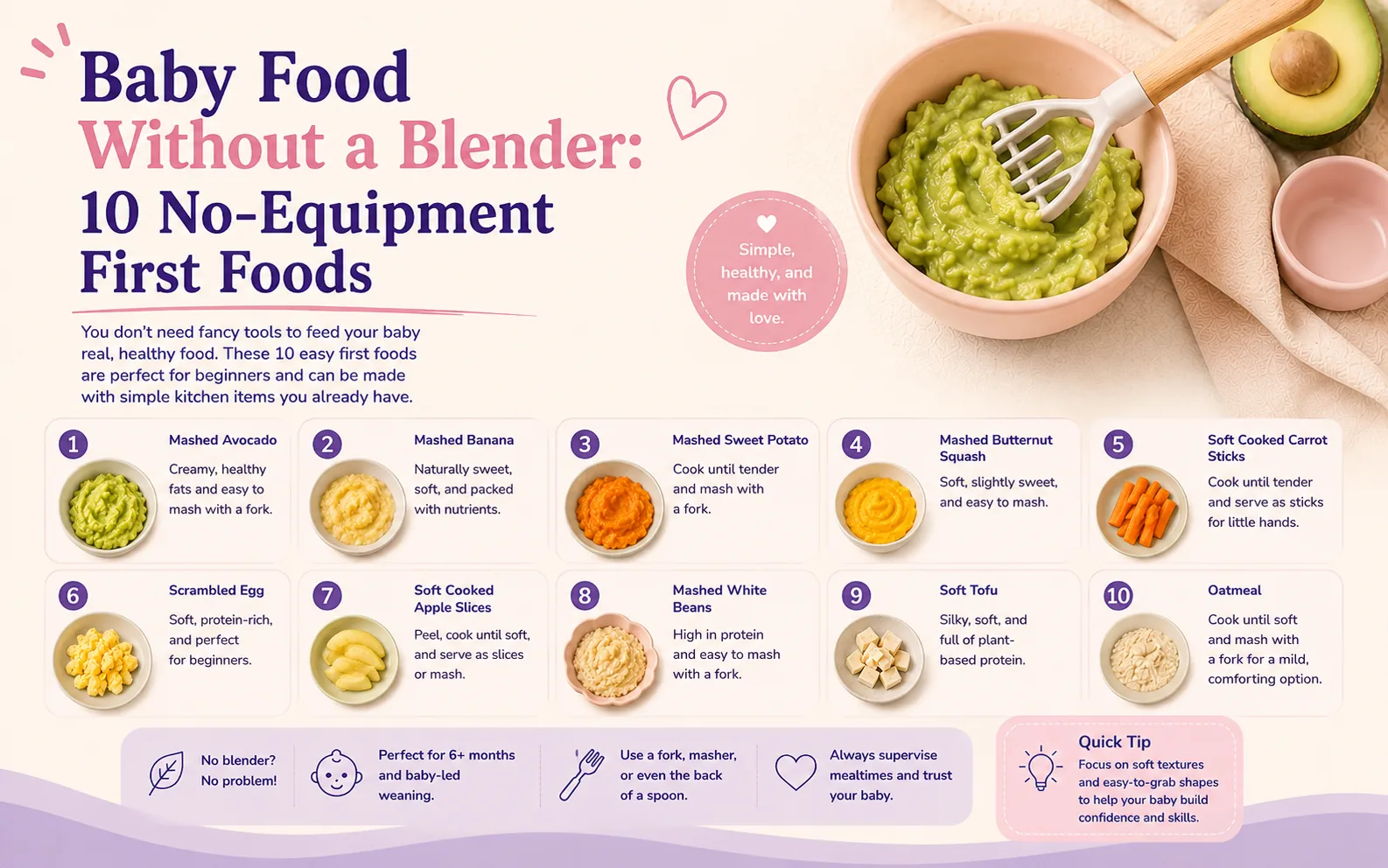
The baby food industry wants you to believe you need specialized equipment to feed your baby well. Baby food makers, high-speed blenders marketed specifically to parents, steam-and-blend systems that cost hundreds of dollars — all of them carry the implication that homemade baby food without the right tools isn't good enough.
It's not true. Generations of babies were fed without any of it. The foods that work best as first purees are, almost without exception, foods that mash easily with a fork. Some don't even need cooking. The learning curve is low, the cleanup is fast, and you're in control of every ingredient.
Here are ten first foods that require zero special equipment — just a fork, a pot for the ones that need cooking, and a little time.
What You Already Have
Before you start, take stock of what's actually in your kitchen. You need:
- A fork — the most important tool for no-blender baby food
- A small pot or saucepan for steaming or simmering
- A small bowl and spoon for serving
- Breast milk or formula on hand for thinning
That's genuinely all you need for the majority of first foods. A fine mesh strainer or sieve is helpful for a few of them but not required. You likely already own one.
10 No-Blender Baby Foods
No cooking required. Cut a ripe avocado in half, remove the pit, scoop out the flesh, and mash with a fork until smooth. Add a splash of breast milk or formula if you want a thinner consistency. Avocado is one of the easiest first foods to prepare and one of the most nutritious — high in healthy fats and easy for new digestive systems to process. Use immediately after mashing, as avocado browns quickly.
No cooking required. Peel a very ripe banana and mash it thoroughly with a fork. Ripe bananas — with plenty of brown spots — mash to a near-smooth consistency without any equipment at all and are sweet enough that most babies accept them immediately. Banana is high in potassium, vitamin B6, and easily digestible carbohydrates. It also pairs well with avocado, Greek yogurt, and nut butter for a more nutrient-dense serving.
Steam a peeled, cored, ripe pear until very soft — about 5 to 8 minutes. Remove from heat, let cool, and fork mash. Very ripe pears may not need steaming at all if the flesh is soft enough to press through easily. Pear has a high sorbitol content, which makes it particularly good for babies who are constipated. It also has a mild, sweet flavor that blends well with almost any other vegetable puree.
Bake or steam a sweet potato until completely tender — an hour in the oven at 375 degrees Fahrenheit, or 15 to 20 minutes of steaming. The cooked flesh scoops away from the skin easily and mashes smooth with a fork without any effort. Sweet potato is one of the most reliably accepted first foods, high in beta-carotene, vitamin C, and fiber. Add a little breast milk or unsalted butter and mash to your baby's preferred consistency.
Roast butternut squash halves cut-side down at 375 degrees Fahrenheit for 40 to 50 minutes until the flesh is completely soft. Scoop the cooked flesh into a bowl and mash with a fork — it comes apart easily and mashes very smooth. Butternut squash is naturally sweet, high in vitamin A and potassium, and has a silky, creamy texture when cooked well. A small knob of unsalted butter stirred in adds calories and improves texture.
Steam or boil peeled carrot pieces until they're completely tender — soft enough to press flat between two fingers with no resistance. This takes longer than you'd expect: 15 to 20 minutes of steaming for small pieces. Fork mash until smooth, adding a little cooking water, breast milk, or formula to thin. Carrot puree is sweet and orange, which makes it visually appealing to babies, and it's high in beta-carotene and vitamin K.
Canned 100% pumpkin puree (not pumpkin pie filling) is one of the few ready-to-use no-prep baby foods you can buy — it's already smooth, plain, and appropriately textured for babies. Just spoon it out and serve. If using fresh pumpkin, roast it the same way as butternut squash and fork mash the soft flesh. Pumpkin is high in vitamin A and fiber and has a mild flavor that pairs well with apple, pear, and cinnamon (for babies 8 months and older).
Cook frozen or fresh peas until completely soft, then press through a fine mesh sieve or strainer using the back of a spoon. The flesh passes through easily, leaving the skins behind. The result is a smooth, bright green puree that's high in fiber, protein, and iron. This is one case where a strainer makes a meaningful difference in texture — pea skins can be tough for young babies if left in. Canned peas work too; rinse them first to remove excess sodium.
Red lentils are one of the best-kept secrets in no-blender baby food. When cooked in plenty of water or low-sodium vegetable broth, red lentils dissolve almost completely on their own — no blending, no straining, no special equipment. Simmer 1/4 cup of rinsed red lentils in 1 cup of water for 15 to 20 minutes, stirring occasionally, until the lentils have broken down into a thick, smooth porridge. Let cool and serve as-is. High in protein, iron, and complex carbohydrates.
No cooking required if the mango is very ripe. Cut the flesh away from the pit, scoop it into a bowl, and fork mash until smooth. Very ripe mangoes have a stringy fiber that may not fully smooth out with a fork — run it through a strainer if that's a concern, or choose a variety like Ataulfo (honey mango) that has much less fiber. Mango is high in vitamin C, beta-carotene, and natural sugars, and its bright flavor is typically well-accepted by babies.
Getting a Smoother Texture Without a Blender
Tools that help when a fork isn't quite enough
- Fine mesh strainer or sieve. Essential for peas, beans, and any food with skins or strings. Press the cooked food through with the back of a spoon. Clean-up is fast and the result is noticeably smoother.
- Potato ricer. A potato ricer produces a very consistent, lump-free texture for root vegetables — sweet potato, carrot, parsnip, potato — without any blending. Press cooked vegetables through and they come out smooth and fine.
- Food mill. A hand-cranked food mill with a fine disc produces purees similar to a blender and works on fruits, vegetables, and legumes. It's quieter, easier to clean, and requires no electricity. A good mid-range option for parents who want a step up from a fork without investing in a blender.
- Mortar and pestle. Slower, but works well for soft fruits and very well-cooked vegetables when you only need a small amount. A traditional option that requires no special purchase if you already own one.
Thinning Any Puree with Breast Milk or Formula
The quickest way to adjust the consistency of any fork-mashed puree is to add breast milk or formula. Both thin the texture without altering the flavor significantly, and both add nutritional value. Start with a teaspoon at a time, stirring after each addition, until you reach a consistency your baby can manage.
For very young babies just starting solids — around 4 to 6 months — a thinner, more liquid puree is easier to swallow. As your baby gets more experienced with solid foods over the following weeks and months, you can leave the puree thicker and lumpier to help develop oral motor skills.
BLW note: Almost all of the foods on this list can be offered as soft finger foods instead of purees, making them compatible with baby-led weaning or a combination approach. Soft-cooked sweet potato, butternut squash, and carrot can be cut into thick sticks. Very ripe banana and avocado can be offered in small chunks. Cooked red lentils can be served as a thick porridge with a preloaded spoon. You don't have to choose between purees and BLW — and you definitely don't need a blender for either approach.
When You Might Actually Want a Blender
There are a few cases where a blender or food processor genuinely makes a difference and a fork won't get you there. Meat purees — chicken, turkey, beef — require a blender to reach a safe, smooth consistency for young babies. Fibrous green vegetables like green beans and kale are nearly impossible to smooth adequately without one. And if you're batch-cooking large quantities to freeze, a blender is more efficient.
For those specific needs, a standard kitchen blender you already own works perfectly. You don't need a dedicated baby food maker — any high-powered blender or food processor handles baby food just as well as a specialized machine. If you don't own a blender and want one, an immersion (stick) blender is inexpensive, easy to clean, and works directly in the pot.
But for your baby's first foods, the fork approach will take you further than you might expect.
Track Your Baby's First Foods
Log every food your baby tries — no blender needed for Alara Blooms either. Track reactions, build a history, and know what's working.
Start Tracking Free