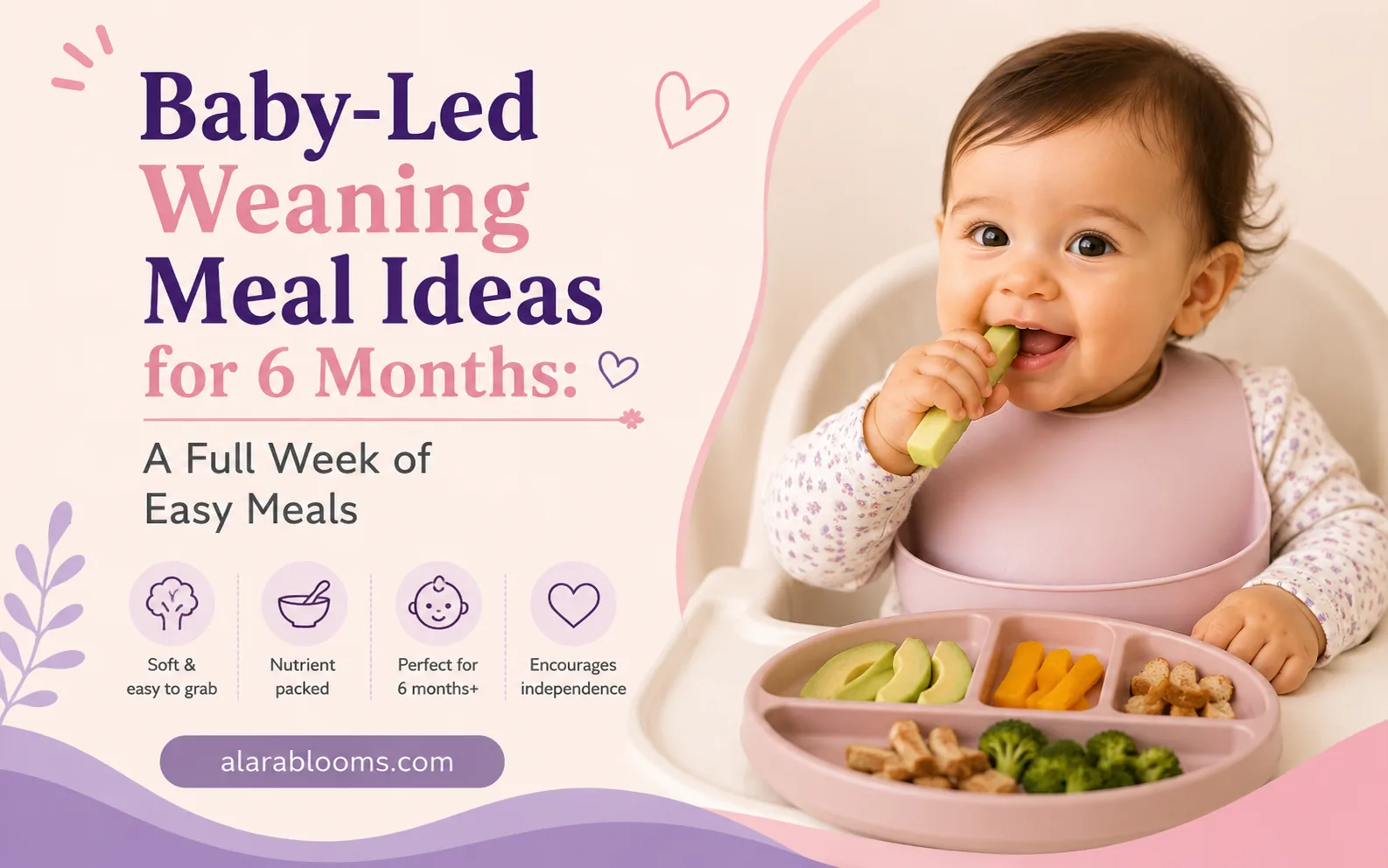
Baby-led weaning can feel intimidating before you actually try it. The idea is simple — instead of spoon-feeding purees, you offer soft finger foods from the very start of solids and let your baby take the lead on how much they eat and how they eat it. In practice, at 6 months, this mostly looks like your baby squishing food between their fingers, mouthing it, dropping it, and occasionally getting a little into their mouth. That is exactly right.
If you have been circling the idea of BLW but feel stuck on what to actually serve, this week-by-week meal plan gives you a concrete starting point. Every food listed here is appropriate for a 6-month-old beginning solids, provided your baby meets the readiness signs below.
A Quick BLW Refresher
Baby-led weaning (BLW) was popularized by British health visitor Gill Rapley and is built on the premise that babies, when developmentally ready, can self-feed soft foods rather than being spoon-fed purees. Parents who choose BLW often do so because it promotes independent eating, exposes babies to varied textures from the start, and makes mealtimes more social — the baby eats alongside the family rather than being fed separately.
A common misconception is that BLW and purees are mutually exclusive. They are not. Combination feeding — offering both preloaded spoons of puree and soft finger foods in the same meal — is a completely valid approach. Many families start with BLW-style finger foods and also offer spoons of oatmeal or yogurt. Both are fine. The goal is for your baby to explore food and develop a positive relationship with eating, not to follow a strict method.
Before you start BLW, confirm your baby is ready: They should be able to sit independently (or nearly so) with minimal support, show interest in food, and have lost the tongue-thrust reflex that automatically pushes food out of the mouth. Most babies hit these milestones around 6 months, but some closer to 6.5 or 7 months. Do not start before 4 months under any circumstances, and always supervise every meal. Never leave a baby alone while eating.
Size and Texture: The Two Rules That Matter Most
At 6 months, babies do not have a pincer grasp yet — they grab with their whole fist. That means food needs to be sized so they can hold it in their palm with some sticking out the top for them to gnaw on. Think long strips or spears roughly the length of an adult pinky finger.
The 6-month BLW size and texture guide
- Size: long spears or strips about 7 to 8 cm (roughly 3 inches) — long enough to hold in a fist with some exposed at the top
- Texture: use the squish test — if you can squish the food easily between two fingers, it is safe. If it resists, cook it longer.
- Never offer round, hard foods (whole grapes, whole cherry tomatoes, raw carrot rounds) — these are choking hazards at this age
- Avoid added salt, sugar, and honey for all babies under 12 months
- Soft foods that melt or dissolve (banana, avocado, very well-cooked sweet potato) are ideal starting points
A Full 7-Day BLW Meal Plan
Each day below lists breakfast, lunch, and dinner. At 6 months, "meals" are short — 10 to 20 minutes — and most food will end up on the floor, the high chair tray, or your baby's face rather than inside them. That is completely normal. Breast milk or formula remains the primary nutrition source throughout the first year. These meals are about exploration, not caloric intake.
Breakfast: Avocado spear — ripe, peeled, sliced into a long wedge. Avocado is soft, mild, and rich in healthy fats. It will get very messy, which is part of it.
Lunch: Soft steamed broccoli floret — steam until very soft (8 to 10 minutes). The floret head acts as a handle for baby to hold and gnaw on.
Dinner: Ripe banana spear — peel most of the way down, leaving the bottom as a natural handle. One of the easiest BLW foods to start with.
Breakfast: Scrambled eggs — cooked soft (not rubbery), served in a small pile on the tray for baby to rake at. Eggs are an excellent early allergen to introduce; serve them regularly once introduced.
Lunch: Sweet potato spear — baked or steamed until very soft. Peel, cut into long strips. Sweet, naturally smooth, and easy to squish.
Dinner: Steamed pear spear — peel, core, and steam until soft (about 5 minutes). Raw pear is too firm at this stage.
Breakfast: Avocado and banana together — mash slightly on the tray if you like, or offer as separate spears. Two foods at once is fine once each has been offered individually.
Lunch: Soft carrot sticks — carrots must be cooked very well (boiled or steamed 15 to 20 minutes until easily squishable). Raw carrot is a choking hazard at 6 months.
Dinner: Butternut squash spear — roasted or steamed until very soft. Cut into long sticks. Naturally sweet and smooth in texture.
Breakfast: Scrambled egg and avocado — both have been offered before, so you can put them both on the tray together.
Lunch: Broccoli and sweet potato — repeat the foods your baby responded well to. Repetition is good at this stage.
Dinner: Ripe mango strip — slice along the seed to get a long strip of very ripe mango, peeled. Ripe mango is naturally soft; underripe mango is too firm and fibrous.
Breakfast: Oatmeal on a preloaded spoon — cook oatmeal to a thick consistency and load a soft baby spoon, setting it down on the tray for baby to pick up. This is the BLW approach to foods that cannot be offered as a finger food.
Lunch: Zucchini sticks — steam or roast zucchini cut into long strips until very soft. Zucchini has a mild flavor and soft texture that works well at this age.
Dinner: Avocado spear — back to the reliable favorite.
Breakfast: Scrambled egg — by now, you have offered egg multiple times. Keep offering it regularly to build and maintain tolerance.
Lunch: Soft peas and avocado — peas should be very soft (canned peas work well here, or fresh boiled until very soft). Place a small pile on the tray. Peas can be squished between the palms.
Dinner: Banana and sweet potato — a mix of two foods your baby has already explored.
Breakfast: Thin layer of peanut butter on a small piece of very soft bread, or thinned peanut butter in oatmeal — for low-risk babies, this is an appropriate time to introduce peanut. See AAP guidelines for higher-risk infants before doing this.
Lunch: Soft steamed carrot stick — a repeat of an established food while a new allergen is also in rotation.
Dinner: Banana spear — keep the rest of the meal simple after introducing a new allergen earlier in the day so any reaction is easy to identify.
What to Expect — and Not to Expect
Most of the food you put in front of a 6-month-old will not be swallowed. At this stage, babies are exploring food through touch, smell, and mouthing — and that is the point. They are learning what food is, how to handle it, and how to move it around their mouths. Actual swallowing is a secondary outcome of these early meals, not the primary goal.
Gagging is normal and expected. Gagging and choking are different. Gagging is a safety reflex — babies gag to move food away from the back of the throat. It sounds alarming but it is protective. Choking is silent, with no airflow. If your baby is making noise, they are gagging, not choking. Stay calm, do not put your fingers in their mouth, and let them work it out. If they are silent, limp, or showing distress with no sound, that is an emergency.
Breast milk or formula is still the primary nutrition through the first year. The foods your baby eats at 6 months are supplemental — they add experience and early nutrients, but they are not yet replacing milk feeds. Do not reduce milk feeds based on how much solid food your baby appears to eat. Let your baby guide both.
Track Your BLW Journey
Log every food your baby explores, note what they actually swallowed vs. explored, and build a BLW feeding history in Alara Blooms.
Start Tracking Free