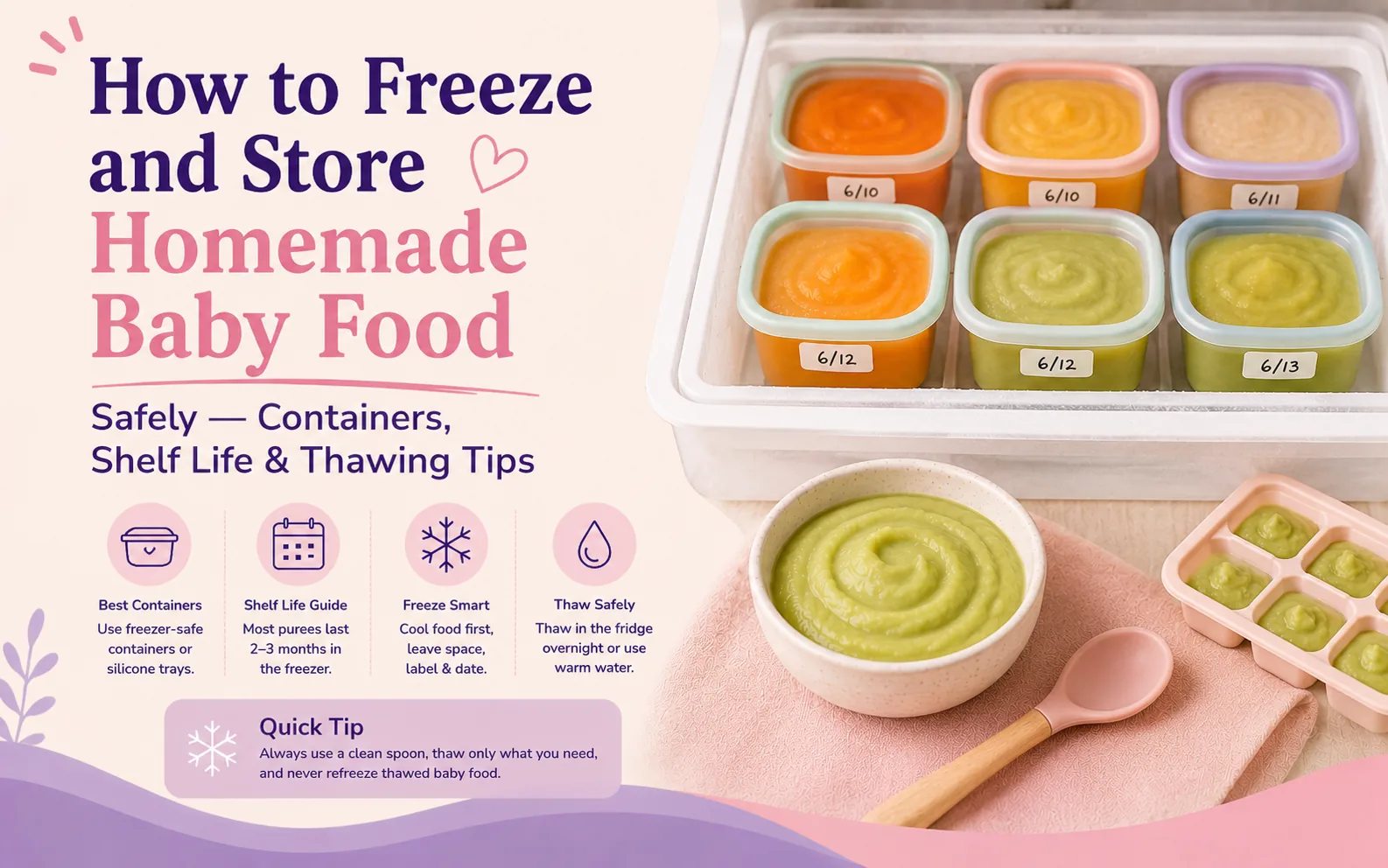
You've done the batch cooking — now what? Getting the storage right is just as important as the cooking itself. Purees stored incorrectly lose quality quickly, and a few simple mistakes (like putting hot food straight into the freezer, or saving leftovers from baby's bowl) can create food safety problems. Here's how to do it properly from start to finish.
Step 1 — Cool It First
Let freshly made puree cool to room temperature first — no longer than 1–2 hours out — then refrigerate or freeze. Putting hot food into freezer containers raises the internal temperature of the freezer and can affect other stored food. If you are in a hurry, set the pot in a bowl of cold water to speed up cooling.
Step 2 — Freeze in Single-Serving Portions
Ice cube trays are your best tool here. Each cube is roughly 1 oz — a perfect single serving for a young baby. Fill the tray, cover with plastic wrap or a silicone lid, freeze until solid (about 4–6 hours), then pop the cubes out and transfer to a labeled zip-lock bag or freezer container. This way you only thaw what you need, and you are never wasting food.
Label everything. Write the food type and date on the bag. Frozen purees all look the same and you will absolutely forget what's what. A simple label like "sweet potato — July 10" takes 5 seconds and saves a lot of guessing.
Best Containers for Storing Baby Food
Standard trays work, but silicone trays are easier to pop out and do not absorb odors. Look for ones with lids to prevent freezer burn and keep flavors from mixing with whatever else is in your freezer.
4 oz mason jars are perfect for storing fresh puree in the fridge for up to 3 days. They are easy to clean, do not stain, and are microwave-safe when you remove the lid. They also stack neatly and let you see exactly what is inside.
Great for on-the-go once baby is a bit older and can self-feed from a pouch. Fill, seal, freeze, and thaw as needed. They clean up well in the dishwasher and are a much cheaper alternative to single-use store-bought pouches over time.
After cubing in ice trays, transfer the frozen cubes into labeled freezer bags. They take up less space than hard containers, lie flat in the freezer, and you can see exactly what is inside. Use freezer-grade bags, not regular sandwich bags — the thicker plastic prevents freezer burn.
How Long Does Homemade Baby Food Last?
| Storage Method | How Long It Lasts |
|---|---|
| Room temperature | 1–2 hours max |
| Refrigerator (fresh) | 48–72 hours |
| Freezer (purees) | 1–3 months (best quality) |
| Freezer (meat-based purees) | 1 month |
| Freezer (fruit purees) | Up to 3 months |
Frozen puree will not go bad past these dates from a safety standpoint if stored at a consistent 0°F, but quality, flavor, and texture will decline. Use within the recommended window for best results.
How to Thaw Baby Food Safely
Move the cubes from the freezer to the fridge the night before. They will thaw slowly and safely by morning and will keep for up to 24 hours once thawed. This is the safest and most hands-off option — no monitoring required.
Place the sealed container or bag in a bowl of warm (not hot) water for 20–30 minutes. Change the water once if it cools down. Always check the temperature on your wrist before feeding — it should feel neutral, not warm.
Microwave in short 15-second bursts, stirring between each round. Microwaves heat unevenly and can create hot spots that burn baby's mouth. Always test the temperature on your wrist before feeding, and make sure you stir thoroughly to distribute heat evenly before checking.
Track Your Baby's Feeding Journey
Keep a record of every puree your baby tried, when they loved it, and when they didn't. Alara Blooms makes solid food tracking simple.
Start Tracking FreeDo's and Don'ts
Do
- Label with food type and date
- Cool before freezing
- Freeze in single portions
- Thaw in fridge overnight when possible
- Use within 24 hours of thawing
- Check temperature before feeding
Don't
- Refreeze thawed puree
- Leave puree out more than 2 hours
- Store uneaten food from baby's bowl
- Freeze purees with added salt or sugar
- Microwave in the original plastic storage container
The One Mistake Most Parents Make
Storing leftovers from baby's bowl. Once baby has eaten from a bowl, their saliva breaks down the food and introduces bacteria. Never put unfinished puree from a feeding back in the fridge or freezer — toss it. Always serve from a separate portion and keep the rest stored cleanly. This is one of those rules that feels wasteful until you know why it matters.
Which Purees Freeze Best?
Almost all vegetable and fruit purees freeze well. A few exceptions worth knowing about:
Purees That Do Not Freeze as Well
- Avocado — browns and changes texture in the freezer; best made fresh
- Banana — texture gets mushy after freezing, though still fine to use in oatmeal or smoothies
- Yogurt-based purees — can separate after freezing; stir well after thawing
- Purees with potato — starchy textures can get gluey after freezing; still safe, just a different consistency
For everything else — sweet potato, squash, peas, carrot, pear, apple, mango, spinach blends — the freezer is your best friend. Purees freeze cleanly and thaw well, which is exactly what makes batch cooking such a practical strategy for the early months of solids.